Showing posts with label Wayne Mallinger. Show all posts

Thursday, March 8, 2012

early herons claim best nests

•


Great blue herons spend most of their lives as solitary hunters quietly fishing local shorelines, battleship-gray loners the same color as fresh-set cement. Rock solid. Steely-eyed. Rapier-billed. Each heron seems to have a favorite fishing hole. But, mum's the word.


Everything changes at breeding time; there's safety in numbers. They all come together as colonial nesters, creating rookeries, filling the trees with large stick condos like high-rises on Miami Beach. A single tall sycamore can have multiple nurseries, precariously placed on the uppermost branches. The nests are so well built, they can be used year after year.

In late January, male great blues begin to arrive at the rookery to stake their claims. They don’t necessarily use the same nests they used the year before. If they arrive early enough to claim a better-located one, they will. 


What determines a better site? Only a heron knows and they are remarkably tight-billed on the subject. Perhaps it's the scenery. Wanted: river-front condo with view of sunset. Or maybe it's accessibility. Great blues are hopelessly lankly, those long legs, bills and wings make pinpoint landing on a branch problematic. 


If they arrive at the rookery too late, they may have to build a nest from scratch. It’s first come, first served. This declaration-of-site marks the beginning of courtship. By early March, most nests have already been claimed and the females are beginning to join their mates. 

There's a family to raise.


Photos by Wayne Mallinger


Sunday, December 25, 2011

Merry Christmas

•


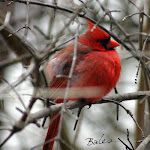
My friend Wayne Mallinger sends Christmas tidings.

And what better bird to convey the sentiments 
than the male cardinal. 
Always dressed for the season.

Photo by Wayne Mallinger.

• 

Saturday, November 26, 2011

a towhee by any other name?

•


Eastern towhee (Pipilo erythrophthalmus)
A towhee by any other name would...the eastern towhee is a large New World sparrow. Yes, sparrow. It doesn't look like one but it certainly acts the part. Hides in the bushes, feeds on the ground, etc. etc. They are more closely related to Old World buntings than Old World sparrows but that is a can or worms, so we'll just talk about towhees. 

If you have an older field guide, this bird was once called the rufous-sided towhee but several years ago it was split from the more western population and what emerged was two species: the eastern (Pipilo erythrophthalmus) and the spotted towhee (Pipilo maculatus). Apparently, they knew the difference all along, it just took us awhile to catch up.


Wayne's photo is of the male eastern, the female is brown in the places that he is black. But, they already know that. I wonder if they know the difference between the New World sparrows and Old World sparrows. Or does it even matter?

N'est-ce pas?


- Photo by Wayne Mallinger

•

Thursday, November 24, 2011

thankful for pumkin'

•


Pumpkins have always been a part of our Thanksgiving holiday. The first festival in 1621 brought together the Pilgrims and the Wampanoag, the Indian tribe who helped the Plymouth Colonists adapt to their harsh new land. The first feast was composed of fish, duck, geese, wild turkey, venison, cornbread with nuts, succotash—an Algonquian dish of shelled beans and green corn—and for dessert, pumpkin stewed in maple sap. 

This last item interested me. 

What would such a dish taste like? To find out, a few years ago, I bought a locally grown "cooking" pumpkin from a produce vendor. Since maple sap is a little hard to come by at this time of the year, I next purchased a jug of pure, organically grown maple syrup from the local Food Co-Op. To make sap, I diluted the syrup with water which is what producers of maple syrup do, except in reverse.
    

To be authentic, I built a fire in the fireplace and stewed chunks of pumpkin in the maple sap. After about a hour and half the dish was done. The pumpkin dessert had the look and consistency of spiced apples but its color was more orange. It was surprisingly good although somewhat smoky tasting.
    

Now, I wonder what kind of nuts the Pilgrims put in their holiday cornbread.

Happy Thanksgiving.

- Photo by Wayne Mallinger. Thanks.


•

Wednesday, September 28, 2011

Oh Canada

•

Canada Goose (Branta canadensis)
"'OH CANADA, WE STAND ON GUARD FOR THEE'.......like offering a stranger a drink of water, and they never leave. It's fall and the pond is filling up with guests," writes my friend Wayne Mallinger.

Once upon a midnight dreary, Canada geese only passed through our state in the spring and fall migrating to warmer climes in the South to spend their winters. But, somewhere along the line they realized the middle latitudes were commodious year round. 

When I was a child, the first BIG book on birds we had in our home, Pearson's Birds of America originally published in 1917, states, "The great breeding grounds of this Goose are in the British provinces, few, if any, of the eastern flight pausing in spring south of the Canadian border." 

Today, they have become ubiquitous in Tennessee and we tend to look past them, but Wayne's photo shows how big and powerful they truly are.


Depending on which book you consult, there are six or seven separate sub-species or populations only varying in size and location. The ones farther north are bigger. Sibley lists six groups: Aleutian, Richardson's, cackling, lesser, dusky and the widespread "common." 

As Wayne's photo illustrates, they are so large, when they take off from land or water, Canada geese have to run a step or two before they can lift off. This makes them look like they are walking on water. Impressive either here or in Canada. 

- Photo by Wayne Mallinger

•

Sunday, September 11, 2011

Ten years after

•

"I'd love to change the world, But
I don't know what to do"
- By Alvin Lee and Ten Years After, 1971


Photo by Wayne Mallinger

•

Saturday, August 20, 2011

Keeping house


•

House wren (Troglodytes aedon)

When we think of nesting wrens in our state, we think of Carolina wrens. (OK, this is not Carolina but the entire state of Tennessee before 1796 was part of the Tarheel State, so it once was Carolina.)

Carolina wrens nest any and everywhere around our homes, carports, garages, decks, mailboxes, vacant cars, porch swings, etc. etc. They are abundant and widespread and not particularly shy. They'll nest in your lunchbox if you leave it open long enough, so diner beware.

On the other hand, the smaller house wren tends to migrate through our area. They can be found year round in large parts of South America but another population migrates north as far as Canada in the northern summer. This means the perky petite passerines can be found nesting from southern Chile to mid-Canada. That's a large range for a perky petite passerine that's roughly four inches long and weighs 11 grams, the equivalent of two U.S. quarters. 


The nesting that does occur locally is concentrated in the Tri-cities, the northeast corner of the state. But nature is exuberant with "exceptions to the rule." A few house wrens do nest here and there in the Tennessee Valley, but not in great numbers. It's more higgledy-piggledy. When they nest it tends to be near our homes in suburban settings with shade trees and lawns. They'll use nest boxes and have been known to add spider egg sacs to the nesting materials, so that the resulting spider hatchlings can control any outbreak of nest mites. Natural pest control.

My photographer friend Wayne
Mallinger sent me these two beautiful photos he took this past nesting season in Madisonville.

Thanks, Wayne.


Photos by Wayne Mallinger
•

Tuesday, June 28, 2011

the redder the better

•

House Finch (Carpodacus mexicanus)

Male house finches—once sold in pet stores as Hollywood finches—come in a variety of reds: from super intense New Jersey fire engine scarlet to a muted down and pale red-orange.

Studies have shown that if two males are together, a female will pick the male that is the most RED.

And the reason is fairly simple, the male that has eaten the best, most nutritious diet over the past year develops the reddest plumage. So the redder one is the healthiest and she wants a healthy father for her clutch.

This is another great photo from my friend Wayne Mallinger

•

Wednesday, April 20, 2011

oily anniversary


•


One year ago today, April 20, 2010, the Deepwater Horizon oil rig exploded at 9:45 p.m. CDT. Eleven workers were killed in the blast and the resulting oil spill took three months to stop. It was the largest marine oil spill in the history of the petroleum industry. Oil tar balls still wash ashore along the Gulf.

How much crude oil was spilled? USA Today reports, "Federal officials estimated the amount at more than 200 million gallons of crude, while acknowledging the estimate could be off by plus or minus 20 million gallons." The mystery is: Where did it all go? Apparently, most of it did not reach the surface. A sizable amount, a cloudy dark mass, is drifting below the surface. The seabed around the site is also a dead zone. The long term affect is unknown.

One year ago, the oil that surfaced impacted thousands of species, but perhaps none more than the brown pelican. Will their population recover?

Here are two more pelican photos by my friend Wayne Mallinger.


•

Thursday, April 7, 2011

lonely cloud


•


"I wandered lonely as a cloud
That floats on high o'er vales and hills,
When all at once I saw a crowd,
A host of golden daffodils;
Beside the lake, beneath the trees,
Fluttering and dancing in the breeze."


- Opening to the poem "I Wandered Lonely as a Cloud"
a.k.a. "Daffodils" by William Wordsworth,
English poet born on this date: April 7, 1770.

- Photo by Wayne Mallinger

•

Friday, April 1, 2011

feeding hummingbirds

•


Hummingbird feeders? It's that time.

The rule of thumb in our area is to keep your hummingbird feeders out: crazy day to crazy day, i.e. April Fools Day to Halloween.

Mix your sugar water: 4 parts water, 1 part sugar. It does not have to have any red dye in it, nectar is colorless.

And today is April Fools Day. So no fooling, it's time to put out your feeders.


- Photo by Wayne Mallinger

•

Monday, March 14, 2011

watch your back

•


"Don't let yourself get distracted from matters at hand, as soon as you let your guard down to smile or mug for the camera, someone else might want your position. Watch your back!"

Writes my friend Wayne Mallinger. And his recent photo illustrates the point.

•

Tuesday, February 22, 2011

so stop me if you've heard this

•


An ibis goes into a bar and orders a beer, and the bartender asks:
"So why the long face?"

Ba dum chhh!


(Perhaps it read yesterday's post.)


- Photograph of the American white ibis (Eudocimus albus)
and supportive humor by my friend Wayne Mallinger.

•

Thursday, January 13, 2011

in memoriam


•


Dear Stephen.


My 86 year young mother passed on January 3.


She so loved your blog and how you published my photos and stories....she had you on her “favorites."


My love for birds, animals and Mother Earth all were passed to me from her at my birth. I don’t have access to my computer but I found that she had “saved” every e-mail I had sent with a picture attached. Oh, how she loved the seabirds (all animals).


I hope to return to Tennessee soon, don’t know how much longer I can stand the weather here in Ft. Lauderdale...77 & sunny every day :)


Wayne Mallinger


Hello Wayne. I’m sorry to learn of your mother’s passing. Thanks for the gull photo. I’ll post it in honor of your mother.


•


Tuesday, November 2, 2010

autumal palette

•


Wayne Mallinger writes,

"Nature's well worn palette...I've spent the last two weeks enjoying the fall colors at all levels, the heights of the mountains, to the floor of the forests as they slowly make their way down to the valley.....Bald River Falls in the Cherokee National Forest late Monday afternoon served up an eyeful (as always). Wind & rains on Tuesday accelerated the fall process."

Indeed. The leaves seem to be morphing overnight, showing their true colors.

Thanks, Wayne!


•

Thursday, October 28, 2010

mobbed

•


Wayne Mallinger from Madisonville writes,

“When the hunter becomes the harassed. A red-tailed hawk gets unmercifully harassed by crows while hunting. Do the crows know that the hawk will not turn and has no interest attacking/killing or fighting back? The hawk ignored or slowly avoided the crows as if they were a minor nuisance, a meal was more important. Eventually the hawk tired of the constant distractions and moved on. Gives new credence that you never want to have to "eat crow.”


Yes. It's a behavior called "mobbing" and the hawk is no threat to the Corvids, it's just mildly annoyed. I've also seen mockingbirds mob a crow, so turn about is fair play.

Wayne’s photo also gives us a chance to review the field markings of a red-tailed hawk; the rufous colored tail is not always easy to see, the light has to hit it just right. And in this photo, the belly band across the raptor’s middle is hard to make out.


•

Friday, October 22, 2010

where two states meet

•


If you live outside of the American South and wonder what it looks like where East Tennessee and Kentucky meet, i.e. the Cumberland Gap, the land of Daniel Boone and the Wilderness Trail, then here's a photo sent to me by Wayne Mallinger.

•

Sunday, October 10, 2010

first eagle

•


"Alone with the morning sunshine, I was left sitting in the middle of a state I did not know, like a man with no home, untethered to anything other than the planet itself like Kerouac’s Sal Paradise on the road. Paraphrasing him, “the golden land lay ahead…where all kinds of unforeseen events wait lurking to surprise you and make you glad you’re alive to see.” At that moment, I could have walked away from the rented car and all I had known; followed the scrub jay’s leave and found answers to my questions; and with that perhaps even freedom...

"Another hundred yards down the track toward the north, a hawk was making itself known, obviously disturbed. Red-shouldered hawks are highly vocal. I stood, turned and had not made three dozen steps toward the ruckus when a tall stand of pines to my left erupted with life. An adult bald eagle bobbed up and down, unfurling its eight-foot wingspan prior to take off. I knew instantly that the bird had been watching me, lost in my vagabond dream. My heart raced as the majestic bird of prey took flight and swooped down over the track, dipping low not 50 feet in front of me. It climbed and sailed off to my right and since the railroad bed was raised for a time we were virtually eye to eye."

"I watched this country’s symbol — talons free of arrows or snakes or olive branches — as it flew to the east and out of sight. Anytime a moment like this unfolds, the world slows, it’s forever etched in your life’s memories."


Photo by Wayne Mallinger.

Excerpt from Natural Histories published by the University of Tennessee Press. Book available at Ijams Nature Center or from the author.

•

Wednesday, October 6, 2010

sophie

•


I heard again from Wayne Mallinger.

"Had the pleasure of attending the Raptor Rhapsody at Cumberland Gap National Historic Park. Raptor Rehabilitation of Kentucky Inc. brought out some of their rescued birds.

"This is a photo of 'Sophie' an American kestrel that had been hit by a car and is now a permanent resident due to wing damage. Sophie has been given a second chance and enjoys showing her beauty to all. "

Once known as sparrow hawks because of their petite size, kestrels are the smallest falcons in our area. Although they are found in the Tennessee Valley year round, we often see more in the winter because many migrate from northern climes to the spend the coldest months in the South.

•

Wednesday, September 29, 2010

sunflowers!!!!

•


I heard once again from Wayne Mallinger:

"I found this farm on Hwy 321 and Friendsville Rd. in Loudon. Photo was taken on September 8. Sunflowers as far as the eye can see."

Thanks, Wayne.

•