Friday, May 10, 2013

to be a dove

•

"Two mourning doves flew down. Indescribable softness of color, pink over grey; the shape of doves is maddeningly beautiful. Their feet were pink in the moss. They have tiny little heads. Their descent, awkward, nervous, twittering, is a disaster more than a descent. Their rising is labored and noisy. They are so slow only their extreme nervousness saves them. But beautiful—oh, beautiful—dove grey, dove rose, dove blue, and the exquisite lines of their stupid little heads."

– From "The Inland Island" published in 1969 by Josephine W. Johnson, who won the Pulitzer Prize for Fiction in 1935 at the age of 24 for her first novel, "Now in November."

•

Thursday, May 9, 2013

outrageous crows

•


American crows are clever. They're also opportunist omnivores. They'll eat anything. 

The ebony Heckle and Jeckles feed on invertebrates—insects and spiders—of all kinds, also carrion, garbage scraps, seeds, nuts, mice, frogs, etc, etc. Whatever is available. I've seen them fly from a robin's nest carrying a sky-blue egg. I've also watched them feed on orange, powdery cheese puffs by the side of the road and periodical cicadas by the belly full.
 
Finicky they are not. Crows are human-like in their appetites; they would eat escargot, calamari and/or pâté de foie gras marinated in Cognac, which is more than I could say for myself. 

The other day I saw a crow burst from a tree flying lickety-split with a limp, dusty gray nestling dangling from its bill. In hot pursuit was the parent mockingbird to no avail. The crow with its meal got away.

OUTRAGEOUS! Kill the monster! You say. But what if the crow only snatched the helpless nestling to feed its own helpless nestling?

Is the survival of one more important than the survival of the other? 

•

Tuesday, May 7, 2013

strong bonded

•


"One Native American story holds that if one cardinal dies, its mate isn't long for the world either, for their spirits are joined forever. They are two bodies but one spirit," writes Jon Young in his book What the Robin Knows.

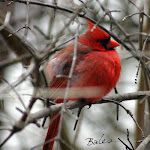
Young says that their bond is so strong, a mated pair of Northern cardinals is rarely separated by more than 30 yards or so, "chipping" companion calls throughout the day, keeping in touch with each others movements within their claimed territory.

Karen Sue saw a male cardinal feeding a female at the feeder, perhaps sealing the deal on the pair's bond.

•

Saturday, May 4, 2013

hit the ground running

•


Hit the ground running, that describes a young killdeer.  

Leggy like their parents, killdeer hatchlings are precocial, able to see and forage and perhaps run a four minute mile soon after hatching. Once their feathers dry, they are good to go.

While at my bank yesterday, I noticed an adult killdeer scampering around the vacant lot next door. Once the home of a car wash nestled between two banks and a four-lane highway, today the building has been razed and all that's left is small chunks of concrete and broken bricks.

I thought it would be a great place to find a killdeer's nest. They are shorebirds that really don't need a shore, when heck, a flat roof top, gravel driveway or vacant lot will do. They are masters at improvising. The inland plovers are also minimal nest builders, just a shallow depression is all they need. But I was a little late. The nest site was empty and three young juveniles were scurrying about with their two parents.

Depression just below center produced three young killdeer.


•

Friday, May 3, 2013

camouflage

•


Why a thing is how it is, is often a mystery.

And looks can be deceiving.

That's true with screech-owls (21 known species). They look how they look for good reason: camouflage. That's the goal. Blending into one's environment is a key to staying out of harm's way, which is why I look like a fading white leather sofa with matching beige afghan.

•

Thursday, May 2, 2013

synchronicity

•


The wild cherry trees are beginning to show their small leaves. And, in a wonderful display of synchronicity, the eastern tent caterpillars are showing themselves as well. Many of the cherry trees have at least one nest.

In early spring the tiny eggs hatch and the caterpillars begin spinning a small silken tent in the crotch of a tree where they live protected during the day. As the caterpillars grow, the size of the nest increases. Putting on the bulk they'll need as adult moths is their sole purpose in life. At night the caterpillars venture out to eat cherry leaves but they don’t always make it back to the safety of the nest.

People often panic when they see these tents in their trees. They want to douse them in kerosene and burn ‘em out. That’s a bit extreme! The nests are really just natural birdfeeders. Only a same percentage of the caterpillars survive, the birds eat most of them. The other day I watched a pair of blue jays in a nearby cherry gobbling down caterpillars as fast as they could.

•

Wednesday, May 1, 2013

the silver bell

•
Wood Thrush. Photo by Steve Maslowski, US Fish and Wildlife Service


“The leaves through which the glad winds blew
Shared. The wild dance the waters knew;
And where the shadows deepest fell
The wood-thrush rang his silver bell.”

(From “The Seeking of the Waterfall” by John Greenleaf Whittier (1807-1892) Quaker poet and ardent advocate of the abolition of slavery. Whittier was one of the “Fireside Poets,” a group of New England poets that also included Henry Wadsworth Longfellow, William Cullen Bryant, James Russell Lowell and Oliver Wendell Holmes, Sr. They were the first American poets whose popularity rivaled that of British poets on both sides of the Atlantic.)

Rejoice! Such absolute beauty. The “silver bell” of the wood thrush has returned to the woods behind my home. Although honestly, Mr. Greenleaf, their song sounds more like a feathered flute to me. Que sera, sera.


•

Tuesday, April 30, 2013

new wren time

•


Spring brings new life! And there are nascent wrens in the valley, flying about, learning how to be wrens.

Once known as "Troglodyte de Caroline" by the French in the New World, I watched the first fledged clutch move around my yard yesterday. A parent Carolina wren with at least three juveniles in tow, begging for food. 

With these ubiquitous wrens, it takes roughly four days for the male and female to build the nest, often near or on our houses. After the eggs are laid, both parents take turns incubating for 12 to 16 days, the nestling phase takes another 10 to 16 days. Once they fledge—fly away from the nest—the young ones follow mom and dad for several days learning how to be Carolina wrens: where to take a bath, roost, find food and what to be afraid of, although I'm not sure that these little dynamos are afraid of anything.

Locally, a pair of wrens may have three broods a year, which sounds exhausting, and probably is, but you would never know it because these smallish brown birds are high energy, always on the move. Always spunky. Always singing.

One researcher counted and a single herky-jerky Carolina wren sang its song 3,000 times in one day.

Ijams staff member Rex McDaniel, took the above photo of a wren that had nested next to his air conditioner window unit. 

•

Sunday, April 28, 2013

grosbeaks by the score

•


This has been a great year for rose-breasted grosbeaks passing through the valley to points farther north.

Every day for ten days they have been at my feeders. The first few days only males, sometimes three at a time, then females.

Wow! What a sight. Love those bleeding red bibs.

Henry David Thoreau wrote in his journal on May 24, 1855: “Hear a rose-breasted grosbeak. At first thought it a tanager, but soon I perceived its more clear and instrumental—should say whistle, if one could whistle like a flute; a noble singer, reminding me also of a robin; clear, loud and flute-like; on the oaks, hillside south of Great Falls.”

For more about their life history, go to: grosbeak.


•

Saturday, April 27, 2013

peaceful canoe outing

•


Mead's Quarry Lake at Ijams Nature Center

Thank you to all who joined me early last evening for a gentle paddle around Mead's Quarry Lake. The end of day tour of the 25-acre accidental lake—man made, a by-product of the quarrying operation that ended at the site in the late 1970s—was an Ijams Nature Center family program. For information about our May offerings and outings go to: Ijams events. 

Even though it was overcast, the conditions on the water were ideal. Placid and peaceful.

Here's a brief five-second video.


•

Wednesday, April 24, 2013

royal cerulean blue


•

Cerulean Warbler. Wiki photo by mdf


The Royal Blue Unit of the North Cumberlands Wildlife Management Area is not named in honor of the cerulean warbler but it's appropriate to think so. It's one of the few places the sky-blue passerines still nest in North America. One of the very few.  

The cerulean is the fastest declining neotropical migrant songbird, with its overall population dropping quicker than any other warbler species in this country. Its population in 2006 was less than one-fifth of what it was 40 years before.

Monday, I accompanied Tiffany Beachy and Lee Bryant to Royal Blue, specifically to several plots she monitored from 2005 to '07, as part of her cerulean warbler field research under the tutelage of Dr. David Buehler with the University of Tennessee.

Beachy, the Citizen Science Coordinator at
the Great Smoky Mountains Institute at Tremont, is currently monitoring Louisiana waterthrush in Walker Valley as part of a citizen science project. She's a superb birder with an ear for nuance, the way a mother hears the sighs and moans of her infant in the crib two rooms away. Today, her field work on the cerulean is over but she still likes to keep in touch with the Royal Blue. You do not spend three years of your life with a living thing and not develop a strong bond. 

After Beachy, UT doctoral candidate Than Boves continued research in Royal Blue and elsewhere. For information on his work, go to Boves.  

Despite the scars from logging and coal mining, the Cumberlands are beautiful the way a rumpled unmade bed is beautiful and cozy. And the most beautiful things in the rolling mountains are the lively, colorful pixies: the redstarts, the ceruleans and the hoodeds, to name a few.

On Monday, getting to the preferred habitat of the enigmatic canopy-loving warbler was an adventure in itself. The old logging roads in the tract are only roads in name only. They're more like bumpy, rutted washouts eroded from years of rain and big wheels, with exposed rocks as large as mama sows laying in mud. And just as obstinate. We bounced up slope in a beast of a truck of our own. It's the only way unless you are prepared to walk all the way to the crest.

Large-flowered bellwort, blue cohosh plus yellow, white and red flowered trillium were just beginning to open their blossoms along the way.  

With the zany yellow-green of spring of the valley left behind, we soon found that the ridge tops still looked more like winter. Bare branched. 

"Yes! You are so beautiful!" Beachy exclaimed when she heard her first cerulean sing its buzzy song.The first she had heard in months.

She was pleased to find three male ceruleans claiming various portions of one special ridge in Plot 3 as their territory. The female ceruleans will have to make choices of their own as soon as they return.

Oh, the wonder of it all!

For more about the cerulean warbler, look for my upcoming new UT Press book:  
Ephemeral by Nature. 


Primo territory already claimed by one male cerulean
on top of ridge before leaves appear
Watching a cerulean warbler from rock outcropping
Old logging road that is only a road in the most general
bumpy, rutty sense of the word.
Lee Bryant and Tiffany Beachy


•

Tuesday, April 23, 2013

finding frog eggs 101

•

Looking for frog eggs with young Burke.

Thank you to those who attended our Frog Walk last Saturday night. We found eggs, tadpoles and adult frogs. And heard half a zillion—more or less—spring peepers peeping.

It must be spring.

     Frogs and toads found at Ijams Nature Center throughout the year.

      American Toad (Bufo americanus) 
      Cope's Gray Treefrog (Hyla chrysoscelis)
      Spring Peeper (Pseudacris crucifer)
      Western Chorus Frog  (Pseudacris triseriata)
      Bullfrog (Rana catesbeiana)
      Green Frog (Rana clamitans)
      Pickerel Frog (Rana palustris)
      Southern Leopard Frog (Lithobates sphenocephalus)
      Eastern Narrowmouth Toad (Gastrophryne carolinensis)

-Photo by Vickles Pickles
•

Monday, April 22, 2013

Thank you, Herndon

•

Visitor Center at Tipton-Haynes

Special thanks to the good folks with the Herndon Chapter of the Tennessee Ornithological Society (TOS) in the Tri-Cities. Last Friday evening, I spoke about my book Ghost Birds, the story of Jim Tanner and his search for ivory-billed woodpecker in the late 1930s. 

Jim Tanner, 1937
After his Cornell/Audubon field research through the Southern swamps 1937-39 and the completion of his dissertation at Cornell, Tanner accepted a teaching position at East Tennessee State University (then known as the Tennessee State Teachers College) in Johnson City only a few miles from where I spoke. Tanner soon became a member of TOS, joining the Herndon Chapter in 1941. After his time in the US Navy during World War II, Tanner began his teaching career at the University of Tennessee in Knoxville.

Our evening meeting was held in the Visitor Center at the Tipton-Haynes State Historic Site in Johnson City, Tennessee.

Thank you, Roy, Rick and Dr. Fred.


•

Sunday, April 21, 2013

Outdoor Knoxfest 2013

•

Outdoor Knoxfest hikers. Mead's Quarry in background.
Photo by Elle Colquitt


Thank you to all who joined me yesterday morning for the nature hike at the Ijams quarries—Mead's and Ross Marble—looking for birds, blooming wildflowers as well as the unique geology of the area. 

We visited both quarry pits and discussed the quarrying operations that occurred there between the late 1800s and 1970s. Both locations are now part of Ijams' 300-plus acres and are located on the Knoxville Urban Wilderness South Loop.

The mid-morning hike was part of this year's Outdoor Knoxfest 2013. For a list of today's activities go to: Outdoor Knoxfest.

For more information about the Knoxville Urban Wilderness South Loop go to: Map.


OKF hikers at the bottom of Ross Marble quarry pit.
•

Saturday, April 20, 2013

thinking of home

•


Ahhh, spring and the return of oceans of luxurious color. The azaleas are beginning to bloom.

From the Greek “azaléos” meaning dry, azaleas are generally found in dry soil. A shrub often linked to the Old South, North America actually has at least 16 species of native azaleas found coast-to-coast. Often they are divided into three groups: the whites, the pinks and the reds-to-orange.

But azaleas are also found, even revered around the world. In China, the azalea is known as "thinking of home bush" (xiangsi shu), while the flowering shrubs are often immortalized in Chinese, Japanese and Korean poetry.

And now a bit of homespun haiku:

Azalea flower
explode the red in my heart.
Springtime's passion.

•

Friday, April 19, 2013

most perfect refreshment

•


"To sit in the shade on a fine day and look upon the verdant green hills is the most perfect refreshment."

- Jane Austen (1775-1817) English novelist

All of the trees in the Tennessee Valley seem to have unfurled their new leaves at the same time; the lovely fresh yellow-green of spring is everywhere you happen to look or sit.

Indeed, the most perfect refreshment for my tired winter-gray eyes, which brings to mind another woman of literature. Like the Baby Suggs character in Toni Morrison's novel Beloved, my eyes were hunger for color. The past two days, I've been drinking so much of it, I'm now drunk with color. 

Oh, the bliss.


•

Tuesday, April 16, 2013

proud fathers

•

Rose-breasted Grosbeak (Pheucticus ludovicianus)

File this under "Good Fathers" as opposed to the "Bad Dads" that I blogged about two weeks ago.

Rose-breasted grosbeaks are passing through the valley, visiting our birdfeeders. Tired from their long flight across the Gulf of Mexico, they pause to refuel on their way to their breeding grounds to the north and in the highest elevations of the Great Smokies and Cumberland Mountains of East Tennessee. 

Their name obviously comes from the red "bleeding" bib of the males. The females are streaky brown but here's the odd thing. The exception to the rule. 

As a general guideline in the bird world, if the male is a bright color and the female more subdued, then she is camouflaged to sit on the eggs and he avoids the nest not wanting to draw attention to the hidden clutch. 

Coming soon! My new book.
But oddly, according to the folks at the Cornell Lab of Ornithology, for several hours during the day, the male rose-breasted takes a turn incubating the eggs. That's proper paternity. The female incubates the rest of the day and all night. Both male and female sing quietly to each other when they exchange places on the nest. That's harmony. And even more surprisingly, perhaps proud to be a papa and risking detection by the local Cooper's hawk, the male sometimes sings his normal song at full volume on the nest. And grosbeaks are robust singers, not wispy like warblers.

Perhaps I am being a bit anthropomorphic, but such concerns are becoming passé since there are clear connections between us and all the rest. The line between human nature and animal nature is proving to be artificial, i.e. man made, a way to separate ourselves from the natural world we feel too superior to be a part of, yet pride cometh before the fall. And in this case, the fall is inevitable.

Be that as it may, isn't the following a good description of proper fathering skills? And how many human fathers do you know that simply do much less and leave their young ones to fend for themselves.   

Not the male grosbeaks.

They help feed the young after they hatch, after which, the mated pair often have a second brood. If so, mom builds the new nest while papa tends the young from the first brood preparing them for independence singing all the while.

That's a proud papa.

And his song? It's often described as robin-like but more intense.


•

Monday, April 15, 2013

heft a gill for luck

•


It seems that everywhere you happen to look there is something historic in bloom. Ahhh, but that’s spring.

Glechoma is a low-growing, creeping ground cover in the mint family. I took the photo at Ijams Nature Center of it growing along the Universal Trail.

Native to Europe and southwestern Asia but introduced to North America, glechoma has now become common in most regions other than the Rockies. Its regional folk names include creeping Charlie, catsfoot, field balm, run-away-robin, ground ivy, and, perhaps the most widely used and my personal favorite, "gill-over-the-ground." But again a natural historian's query: What’s a gill?

Here’s one for my friends in the UK. The term can be traced back to the Saxons. They used the plant in brewing beer as flavoring, clarification and preservative, before the introduction of hops for the same purposes; thus the brewing-related name “gill-o'-the-ground.”

A gill was an unit of measurement as indicated by the chorus from the very old drinking song, “The Barley Mow,”

“Oh the quart pot, pint pot, half a pint, gill pot, half a gill, quarter gill, nipperkin and the brown bowl. Here's good luck, good luck, to the barley mow.“

That’s just great. But what’s a nipperkin?

•

Sunday, April 14, 2013

order from chaos

•

"Seeing clearly in a chaotic situation is the means by which an artist becomes a participant and gains control. It is the difference between a ship sinking or sailing in rough seas. I cannot change the force, but I can be witness to it. The intention is not to tame the chaos but to tap its energy," writes British environmental artist Andy Goldsworthy in his book “Stone.”

All of our lives fall into chaos from time to time, our workplaces become unbearable, loved ones become ill, but somehow we endure holding tight to the tiller.

In the case of the ethereal work pictured above, Goldsworthy looked at a section of the forest floor in the autumn, saw the haphazard, higgledy-piggledy disarray of the fallen elm leaves and rearranged them, creating something of amazing cosmic beauty.

Thus poising the proverbial question: Do we live in a random, chaotic universe or one of truly sublime order?

•

Friday, April 12, 2013

got sass?

•


Sassafras is in bloom but the flowers hardly garner a second look. It’s the other parts of the tree that get all the attention.

The roots are steeped to make sassafras tea and, once upon a time, they were used in the flavoring of root beer that is until the FDA banned the practice because lab tests with animals seemed to indicate large doses of the active ingredient safrole could damage the liver or cause certain kinds of cancer. I assume today, root beer gets its flavor from artificial sass.

Does anyone know a lab rat I can ask "Where do you get your sass?"

The dried and ground leaves of a sassafras tree are used to make filé powder, a spice used in some types of gumbo, Creole and Cajun soup/stew.

But the flowers? Well, they come in handy for making other sassafrases.

- Photo taken in Hardin Valley.

•